Pride and Prejudice
Pride and Prejudice is a sharp, brilliant satire of 19th-century English society wrapped in one of literature's greatest romances. Studying this text rewards candidates who can unpick Austen's masterful irony, her use of free indirect discourse, and her critique of how wealth and class dictate human relationships.
Study Notes
Overview
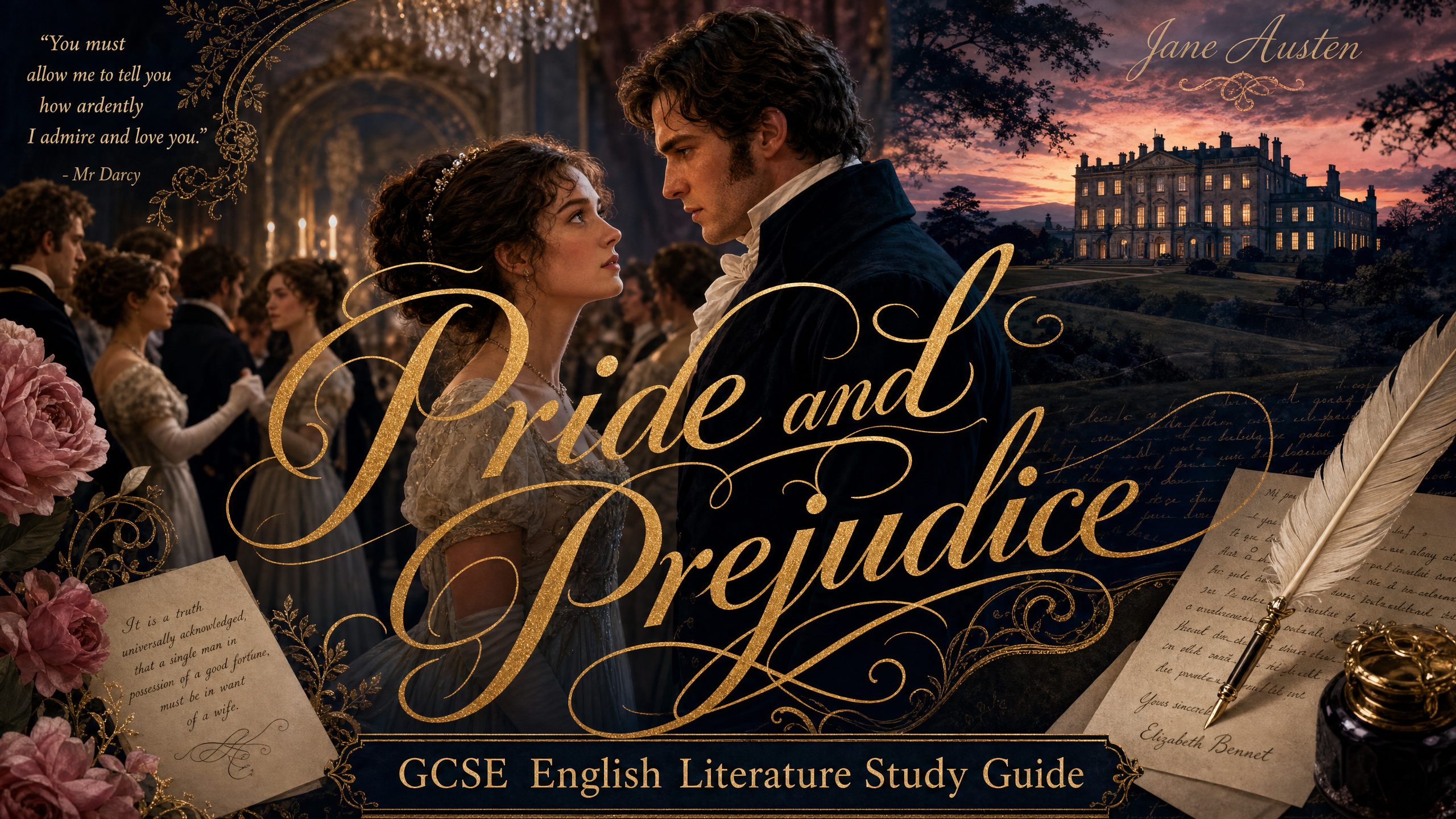
Pride and Prejudice (1813) is a masterful exploration of love, marriage, and social status in Regency England. Originally titled First Impressions, the novel follows Elizabeth Bennet as she navigates the rigid social hierarchy of her time and her own personal biases. Examiners look for candidates who can move beyond the romance plot to analyze Austen's sharp social satire, particularly her use of irony and free indirect discourse. Strong responses will connect the characters' personal flaws (pride and prejudice) to the broader economic realities facing women in the 19th century.
Listen to the companion podcast for this guide:
Plot/Content Overview
Volume I: First ImpressionsThe novel opens with the arrival of the wealthy Mr. Bingley and his even wealthier, aloof friend Mr. Darcy to Netherfield Park. While Bingley is immediately taken with Jane Bennet, Darcy offends Elizabeth by refusing to dance with her. The tension builds as Mr. Collins, a pompous clergyman, proposes to Elizabeth and is rejected, while the charming militia officer Mr. Wickham poisons Elizabeth's mind against Darcy.
Volume II: The Turning PointElizabeth visits her friend Charlotte (who married Mr. Collins for financial security) and encounters Darcy again at Lady Catherine de Bourgh's estate. Darcy unexpectedly proposes, but does so in an insulting manner, leading to a fierce rejection. Darcy's subsequent letter explaining his interference with Jane and Bingley, and revealing Wickham's true, mercenary character, forces Elizabeth to realize she has been blinded by prejudice.
Volume III: ResolutionElizabeth visits Pemberley (Darcy's magnificent estate) with her aunt and uncle, where she sees a changed, gracious Darcy. The crisis hits when Lydia elopes with Wickham, threatening the entire Bennet family with social ruin. Darcy secretly intervenes, paying Wickham's debts to force the marriage. Once Elizabeth discovers this, her feelings are transformed. After Elizabeth stands up to Lady Catherine's demands to back off, Darcy proposes again, and they are happily engaged.
Themes
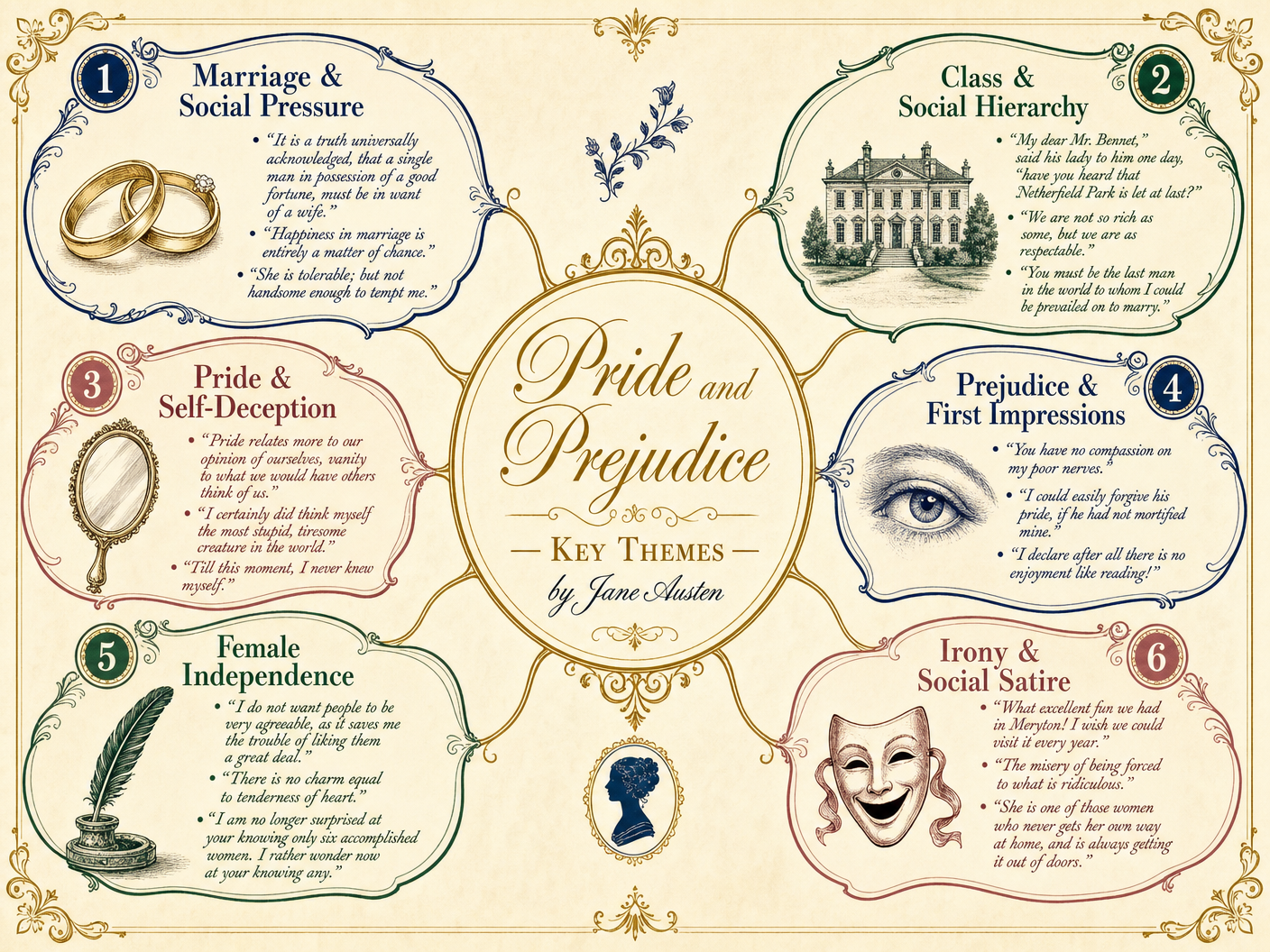
Theme 1: Marriage and Social Pressure
In Regency England, marriage was primarily an economic transaction, especially for women who could not inherit property or work in respectable professions. Austen critiques a society that forces women into loveless marriages for survival (like Charlotte Lucas) while celebrating marriages based on mutual respect and affection (like Elizabeth and Darcy's).
Key Quotes:
- "It is a truth universally acknowledged, that a single man in possession of a good fortune, must be in want of a wife." (Chapter 1) - Austen uses irony to highlight the desperation of families with unmarried daughters.
- "I am not romantic, you know; I never was. I ask only a comfortable home." (Chapter 22) - Charlotte Lucas voices the stark economic reality of marriage for women without fortune.
Theme 2: Pride and Prejudice (Self-Deception)
The novel's title points to the twin flaws that blind the protagonists. Darcy's pride in his social standing makes him dismissive, while Elizabeth's prejudice (based on her wounded pride) makes her judge Darcy unfairly and trust the deceptive Wickham. The novel traces their mutual journey toward self-knowledge.
Key Quotes:
- "I could easily forgive his pride, if he had not mortified mine." (Chapter 5) - Elizabeth reveals that her prejudice against Darcy is rooted in personal offense.
- "Till this moment, I never knew myself." (Chapter 36) - Elizabeth's moment of epiphany after reading Darcy's letter, recognizing her own blindness.
Theme 3: Class and Social Hierarchy
Austen exposes the rigid class boundaries of her society, where landed gentry (Darcy) look down on those with connections to trade (the Bennets' relatives). She satirizes those who are obsessed with rank, like the sycophantic Mr. Collins and the arrogant Lady Catherine.
Key Quotes:
- "Are the shades of Pemberley to be thus polluted?" (Chapter 56) - Lady Catherine's snobbery reveals the aristocratic view of marriage as a matter of bloodline rather than love.
- "He is a gentleman; I am a gentleman's daughter; so far we are equal." (Chapter 56) - Elizabeth asserts her fundamental equality with Darcy, defying class boundaries.
Character Analysis
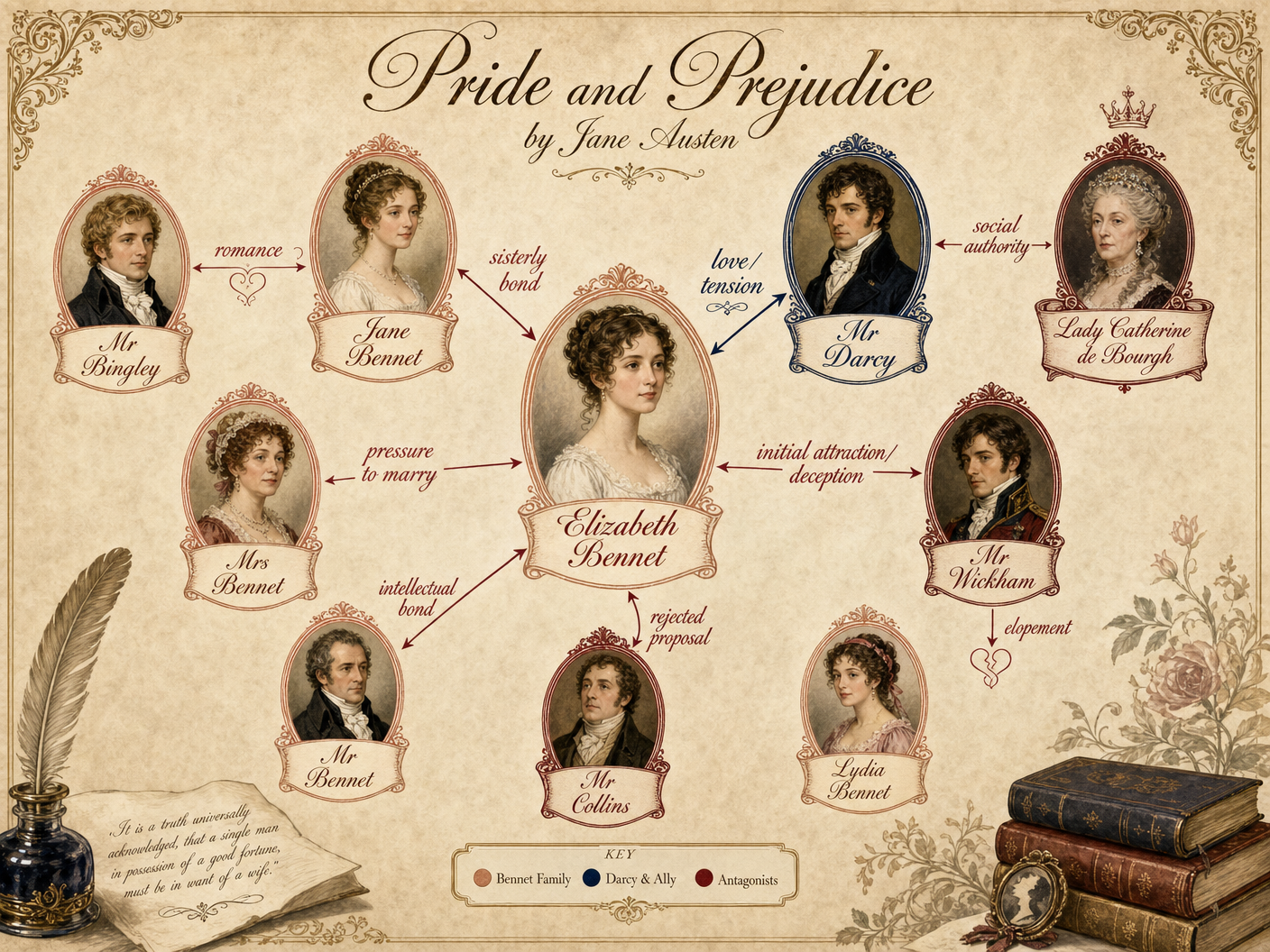
Elizabeth Bennet
Role: Protagonist and moral compass.
Key Traits: Witty, intelligent, independent, quick to judge.
Character Arc: She moves from being blinded by her own 'first impressions' and prejudice to achieving genuine self-knowledge and humility.
Essential Quotes:
- "There is a stubbornness about me that never can bear to be frightened at the will of others. My courage always rises at every attempt to intimidate me."
- "I am no longer surprised at your knowing only six accomplished women. I rather wonder now at your knowing any."
Fitzwilliam Darcy
Role: Romantic lead and initial antagonist.
Key Traits: Proud, reserved, honorable, fiercely loyal to his family and friends.
Character Arc: He must overcome his class snobbery and learn to consider the feelings of others, moving from aristocratic arrogance to genuine humility.
Essential Quotes:
- "She is tolerable; but not handsome enough to tempt me."
- "My affections and wishes are unchanged; but one word from you will silence me on this subject for ever."
Mr. Wickham
Role: The charming villain.
Key Traits: Plausible, handsome, manipulative, mercenary.
Character Arc: He remains static, a foil to Darcy. His surface charm hides a corrupt core, proving the danger of trusting first impressions.
Essential Quotes:
- "His appearance was greatly in his favour; he had all the best part of beauty, a fine countenance, a good figure, and very pleasing address."
Writer's Methods
Free Indirect Discourse: Austen's most powerful tool. The narrator's voice blends with a character's thoughts without using speech marks. This allows Austen to present a character's perspective while simultaneously maintaining an ironic distance to critique it.
Irony and Satire: Austen uses gentle but devastating irony to expose the absurdities of social conventions. The gap between what characters say and what they mean, or what society expects and what is actually moral, is the source of the novel's comedy and its critique.
Epistolary Elements: Letters play a crucial role in advancing the plot and revealing character. Darcy's letter in Chapter 35 is the structural pivot of the novel, shifting the narrative from misunderstanding toward clarity.
Context
The Marriage Market: In Regency England, women could not inherit entailed estates (like Longbourn, which must pass to Mr. Collins). Marriage was the only socially acceptable route to financial security for women of the gentry class.
Social Mobility: The period saw the rise of the middle class (people making money through trade, like the Gardiners) challenging the old landed aristocracy (like Lady Catherine). The marriage of Darcy and Elizabeth symbolizes a reconciliation of these changing social dynamics.
Visual Resources
2 diagrams and illustrations
Interactive Diagrams
1 interactive diagram to visualise key concepts
Conceptual Flow Outline
Elizabeth and Darcy's Relationship Arc
Worked Examples
2 detailed examples with solutions and examiner commentary
Practice Questions
Test your understanding — click to reveal model answers
Explore how Austen presents the relationship between Elizabeth Bennet and Mr. Darcy. You must refer to the context of the novel in your answer.
Hint: Consider how their relationship evolves from mutual dislike (pride and prejudice) to intellectual equality and love. Use the proposals as key structural markers.
Starting with the extract where Mr. Collins proposes to Elizabeth, explore how Austen presents foolish or ridiculous characters in the novel.
Hint: Look closely at the extract for Austen's use of bathos and inflated language. Then connect Mr. Collins to other foolish characters like Mrs. Bennet or Lady Catherine.
Explore the significance of social class in Pride and Prejudice.
Hint: Don't just say 'class was important'. Analyze how Austen critiques those who are obsessed with class (Lady Catherine, Bingley's sisters) versus those who transcend it.
How does Austen use the character of Mr. Wickham to explore the theme of deception?
Hint: Contrast Wickham's pleasing outward appearance with his corrupt inner morality.